
A slow dependency should not be allowed to hold every thread, connection, and byte of working memory in a backend hostage. Yet that is exactly what happens when unrelated requests share one resource pool. A stalled report API can occupy hundreds of workers until login, payment, and status endpoints also time out. The Bulkhead Pattern addresses this failure mode by dividing capacity into isolated compartments so that saturation in one compartment has a bounded blast radius.
This guide applies bulkheads from a backend operations perspective: identify the resource that needs isolation, choose a semaphore or a dedicated pool, bound concurrency and queueing, segment work by dependency or priority, combine isolation with timeouts, circuit breakers, and backpressure, then observe and test the result before production. The objective is not to create as many pools as possible. It is to preserve important functionality when one part of the system is overloaded or broken.
1. What does the Bulkhead Pattern protect?
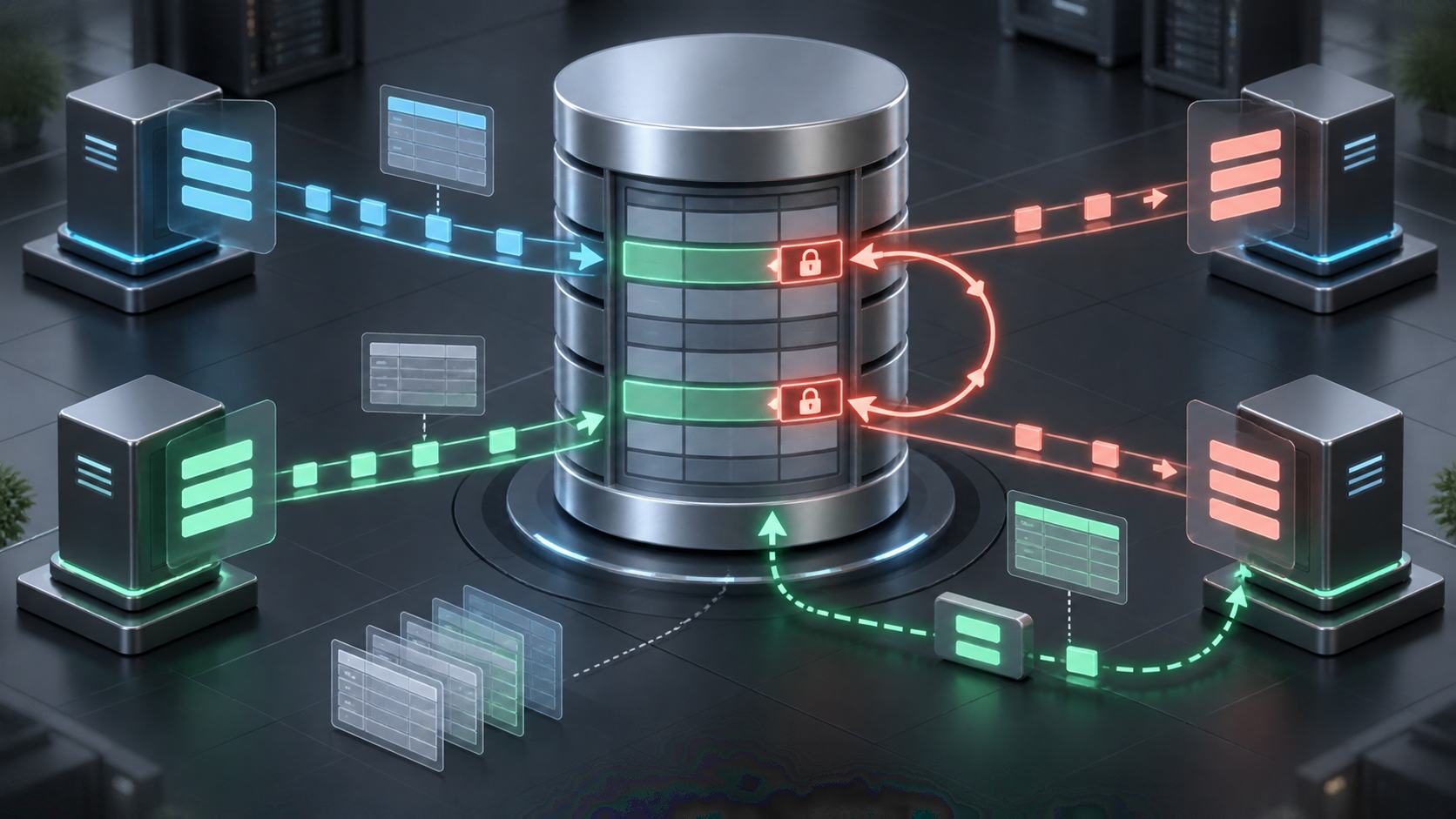
The name comes from watertight partitions in a ship's hull: damage to one compartment does not flood the entire vessel. In software, the partition is a resource boundary. Each class of work can consume only a finite portion of threads, connections, sockets, memory, queue slots, CPU, or service instances. When that portion is saturated, the system rejects or delays that class instead of allowing it to drain shared capacity.
A bulkhead does not repair a dependency or guarantee successful requests. Its value is failure isolation: reporting may pause while authentication keeps running; one noisy tenant cannot remove service from every tenant; a CPU-heavy media zone does not take down transactional APIs. A useful design explicitly answers, “When this compartment is full, which functions must remain alive?”
2. Why shared pools create cascading failure
Consider a service with 200 workers that calls payment, search, and report dependencies. Every report request keeps a worker while waiting for storage. When that dependency slows down, 200 report requests can occupy every worker. Health checks stop getting scheduled, payments cannot execute, client retries deepen the queue, and autoscaling creates more callers that pressure the already unhealthy dependency.
The scarce resource is not always a thread. Analytical queries can consume a shared database connection pool. One host can fill an HTTP connection pool with waiting sockets. Large image jobs can push urgent email work to the back of a shared queue. A tenant can take every available inference slot. The bulkhead should be placed around the resource that saturates first, not merely around the layer that is easiest to annotate.
| Shared resource | Exhaustion scenario | Possible bulkhead |
|---|---|---|
| Workers or threads | Slow downstream calls retain execution slots | Per-dependency concurrency semaphore or pool |
| Database connections | Long reports compete with short transactions | Dedicated pool/read replica plus statement timeout |
| Queue consumers | Heavy jobs block work with a tighter SLA | Separate queues and consumer groups |
| CPU and memory | Thumbnail, PDF, or inference burst | Dedicated process/container and resource quota |
| Tenant capacity | One customer produces abnormal load | Tenant partition/cell and tier-based quota |
3. Choose the isolation boundary deliberately
Strong boundaries commonly follow a dependency, workload class, priority, or failure domain. Dependency isolation prevents one slow host from consuming slots needed for other hosts. Workload isolation keeps long batch tasks away from interactive traffic. Priority isolation reserves capacity for revenue or operational flows. Tenant isolation limits the blast radius of a noisy neighbor.
Do not reflexively create a bulkhead for every endpoint. Too many compartments fragment capacity, multiply configuration, and prevent idle resources in A from helping B. Group operations that share a dependency, latency profile, cost, and recovery requirement. If two flows must survive independently during failure, they should not rely entirely on the same pool.
A bulkhead boundary is a decision about blast radius and business priority, not merely a concurrency-library setting.
4. Semaphore bulkheads and thread-pool bulkheads
A semaphore bulkhead caps concurrent calls while executing on the caller's current execution context. It is lightweight, introduces no extra thread handoff, and can fit synchronous, asynchronous, or event-loop systems as long as waiting does not block the event loop. When permits run out, the call should fail fast or wait only for a short, deadline-bounded interval.
A thread-pool bulkhead submits work to a fixed pool with a bounded queue. It creates a stronger execution boundary for blocking code and stops one task class from consuming the main pool. The trade-offs are queueing, context switches, memory, and more complex propagation of cancellation, traces, and security context. A large queue is not resilience; it usually converts overload into latency and hides the incident longer.
paymentBulkhead:
  max_concurrency: 40
  max_queue: 20
  acquire_timeout_ms: 25

reportBulkhead:
  max_concurrency: 6
  max_queue: 8
  acquire_timeout_ms: 0
These numbers illustrate allocation; they are not portable defaults. Never block an event-loop thread while waiting for a permit. In runtimes with virtual threads or coroutines, thread count might no longer be the first bottleneck, but a semaphore can still be necessary to protect connections, memory, and downstream capacity.
5. Derive limits from the dependency budget
A concurrency limit should start with the measured stable capacity of the dependency and the share the caller may consume. Little's Law provides a useful first estimate: concurrency is approximately throughput multiplied by time in the system. If a dependency reliably serves 100 requests per second with a 200 ms target p95 latency, the mathematical in-flight level is about 20. The production choice must then account for bursts, the latency distribution, replica count, and capacity reserved for other callers.
Do not use the application's worker count as the default limit for every dependency. A backend with 200 workers does not imply that its database accepts 200 additional concurrent queries. Do not split capacity equally when flows have different value. Reserve a budget for critical traffic, keep the aggregate limit across replicas below sustainable downstream capacity, and remember that scaling callers also multiplies their total permits.
- Measure service time and throughput before saturation, not only during an incident.
- Calculate total permits across the fleet, not just one instance.
- Leave headroom for variance, administrative work, and other callers.
- Reduce limits as latency rises only with a tested control strategy.
- Review limits after changes to queries, schemas, timeouts, replicas, or provider quotas.
6. Bounded queues and the full-compartment policy
When a bulkhead has no room, the service needs an explicit contract. A synchronous request often should fail fast with a meaningful response, return cached data, or degrade a nonessential feature. Asynchronous work can use a durable, bounded queue with a priority policy. Waiting for a permit makes sense only when the request still has enough latency budget and the wait itself is bounded.
Queue capacity must correspond to deadlines and drain rate. If workers finish 10 jobs per second while a queue holds 10,000 jobs, the last job waits nearly 17 minutes even with no new arrivals. If its SLA is 30 seconds, most of that queue is already worthless. Reject early, coalesce duplicate work, dead-letter when appropriate, or acknowledge an asynchronous workflow instead of retaining an HTTP connection.
if !reportSlots.tryAcquire():
    metric.increment("bulkhead.rejected", {name: "report"})
    return 503 with Retry-After

try:
    return generateReport(deadline=request.deadline)
finally:
    reportSlots.release()
Every success, failure, and cancellation path must release its permit. Do not immediately retry inside the same request after the bulkhead rejects it. Unsynchronized retries turn controlled shedding into the next attack wave.
7. How bulkheads differ from timeouts, circuit breakers, and rate limits
A timeout bounds how long an operation can retain resources. A circuit breaker stops calls when a dependency appears unhealthy according to a policy. A rate limit bounds requests over time. A bulkhead bounds the resource share or concurrent work owned by one group. These controls complement rather than replace one another.
A limit of 100 requests per second can still produce 1,000 concurrent requests if latency grows to 10 seconds. A circuit breaker needs observations before it opens, and a shared pool may be exhausted during that window. A long timeout holds slots; a short one creates false failures. A practical protection chain uses an end-to-end deadline, admission control or a bulkhead, a call timeout, a circuit breaker, and retries constrained by one shared budget.
- Confirm that the remaining deadline is sufficient for useful work.
- Acquire a permit from the correct bulkhead; degrade or reject if it is full.
- Call the dependency with a timeout below the remaining deadline.
- Record the outcome for the circuit breaker.
- Retry only eligible failures when time, permits, and retry budget remain.
8. Isolate synchronous and asynchronous workloads
Interactive HTTP traffic and background jobs should not automatically share an execution pool. A data-import batch may tolerate minutes of waiting; a payment-status request cannot. Separate queues, consumers, and database pools allow each class to define its own concurrency, deadlines, retries, and scaling policy.
In message processing, separate queues are not enough when every consumer eventually competes for one database pool. The boundary must continue to the resource being protected. Conversely, complete separation at every layer can be wasteful. A shared pool with reserved critical capacity or weighted admission can work if saturation behavior has been tested.
9. Process, container, and cell-level bulkheads
A semaphore isolates concurrency inside one process. It cannot contain a memory leak, runaway CPU loop, or process crash. Workloads with stronger resource risks need a larger boundary: a separate process, a container with CPU and memory limits, a node pool, a database, a deployment stamp, or an independent cell. Stronger isolation reduces blast radius but increases infrastructure and operational cost.
| Isolation level | Protects well against | Does not inherently protect against |
|---|---|---|
| Semaphore | Concurrent-call exhaustion | Memory leaks, runaway CPU, process crash |
| Thread pool and queue | Execution slots for a work class | Shared heap and process failure |
| Process or container | CPU, memory, and crash domain | Shared database or downstream quota |
| Cell or stamp | Tenant blast radius and supporting infrastructure | A bad configuration rolled out everywhere |
Cell-based architecture usually maps a stable tenant group to a relatively independent resource set. Routing must know the tenant's cell, while data placement, deployment, and observability must support the partition. This is an architectural strategy, not a small annotation-level change.
10. Prioritize without starving ordinary traffic
Separate high-priority and standard pools preserve critical flows, but excessive fixed reservations waste idle high-priority capacity and constrain normal work. A reserved-plus-shared model can help: critical traffic always has private permits and may borrow from a common pool, while standard traffic cannot consume the reserve.
Prevent starvation with quotas, fair scheduling, or bounded occupancy time. Priority is meaningful only when it comes from business requirements and callers cannot assign it freely. If every caller labels its work “critical,” the priority compartment becomes another shared pool.
11. Observability for each compartment
Service-wide CPU hides a saturated bulkhead. Each compartment needs metrics for in-flight work, available permits, wait time, queue depth, accepted and rejected calls, execution time, timeouts, cancellation, and downstream outcome. Place those signals beside the corresponding dependency's latency and error rate.
- Alert on sustained saturation, not one isolated rejection.
- Separate capacity rejection from dependency and validation errors.
- Keep metric labels bounded; arbitrary tenant IDs do not belong in labels.
- Add the bulkhead name, remaining deadline, and retry attempt to trace spans.
- Compare reserved and shared utilization to find wasted allocations.
Rejection is not automatically a bulkhead failure. During overload, intentional rejection demonstrates that the boundary is protecting the rest of the service. Evaluate its rate, duration, SLO impact, and whether the fallback behaved correctly.
12. Test failure isolation, not only the happy path
The essential test proves that one compartment can saturate while another flow retains its SLO. Slow or stall the report dependency, fill its bulkhead, then send authentication or payment traffic through another bulkhead. Measure latency, error rate, connections, and memory instead of checking only final response codes.
- Fill a semaphore: excess calls are rejected within the expected time.
- Fill a queue: memory remains bounded and expired jobs do not execute late.
- Trigger timeout and cancellation: permits always return and no slot leaks.
- Increase replica count: aggregate concurrency does not unexpectedly overwhelm the dependency.
- Burst critical traffic: its reserve works without starving standard traffic indefinitely.
- Crash one workload process: deployment isolation keeps other workloads serving.
Production checklist
- The first saturating resource and the functions that must survive are explicit.
- Each dependency, workload, priority, or tenant boundary has a documented reason.
- Concurrency and queues are finite and derived from measured capacity and latency.
- Timeouts, deadlines, circuit breakers, retries, and bulkheads share a coherent time budget.
- Event loops never block for permits, and cancellation releases every resource.
- Aggregate permits across replicas do not accidentally exceed downstream quotas.
- Metrics, logs, and traces distinguish saturation, rejection, and dependency failure.
- Load and fault tests prove that one compartment cannot break another compartment's SLO.
The Bulkhead Pattern succeeds when it turns a system-wide outage into predictable local degradation. Start from an acceptable blast radius, partition the resource that is actually scarce, bound both execution and queueing, and decide in advance how to reject or degrade. One semaphore does not create resilience, but consistent boundaries spanning code, queues, databases, and deployment can keep critical journeys afloat while one dependency is taking on water.



No comments yet. Be the first to share your thoughts.