
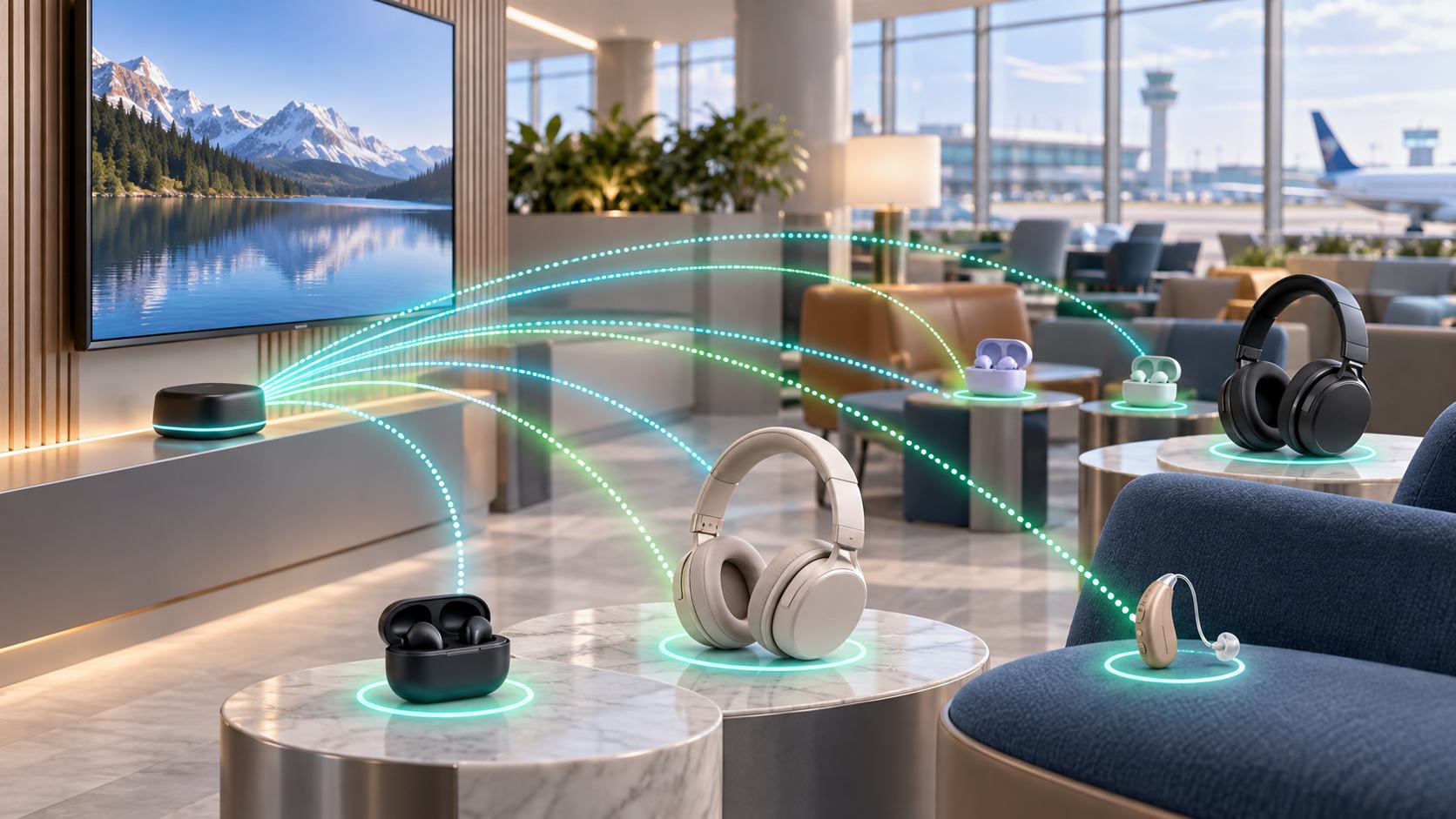
Bluetooth LE Audio is an audio architecture running on Bluetooth Low Energy, while Auracast is a broadcast-audio capability that lets one source reach many nearby receivers. This is more than a new codec: LE Audio adds isochronous channels, multi-stream support, hearing-aid profiles, and a broadcast model unlike traditional point-to-point headphones.
Classic Audio versus LE Audio
Classic Audio uses the Bluetooth Classic radio and familiar profiles such as A2DP and HFP. LE Audio uses the Low Energy radio and a new architecture. Products may support both for compatibility, but LE Audio does not automatically replace Classic Audio everywhere.
| Area | Classic Audio | LE Audio |
|---|---|---|
| Radio | Bluetooth Classic | Bluetooth Low Energy |
| Baseline codec | SBC plus optional codecs | LC3 |
| Streams | Mainly point-to-point | Unicast, multi-stream, and broadcast |
| Hearing aids | Fragmented implementations | Dedicated interoperable profiles |
LC3: efficiency, not magic
LC3, the Low Complexity Communications Codec, is required by LE Audio. Bluetooth SIG reports good quality at lower bitrates than SBC, giving manufacturers flexibility to prioritize audio quality, battery life, or device size. It does not make every product sound better: bitrate, codec implementation, drivers, DSP, microphones, acoustics, and radio conditions still matter.
What does Multi-Stream Audio solve?
LE Audio can carry independent synchronized streams between a source and a coordinated device set. A phone can send appropriate streams directly to left and right earbuds instead of relying on one bud to relay audio. This can improve stereo synchronization, source switching, and management of coordinated devices. Actual support still depends on the product and operating system.
How does Auracast work?
An Auracast transmitter advertises a broadcast and sends one or more audio streams. An assistant, often a phone or another device with a user interface, scans nearby broadcasts and helps a receiver such as headphones or a hearing aid join. The experience resembles selecting a nearby audio network rather than pairing every listener. An in-range broadcast can serve an unlimited number of receivers in the broadcast topology, and it may be open or passcode-protected.
Useful scenarios
- Public televisions: hear silent displays at airports, gyms, or venues.
- Personal sharing: several listeners join the same source.
- Conferences and tours: select a speaker, interpretation, or guide channel.
- Assistive listening: send venue audio directly to compatible hearing devices.
- Multiple screens: choose the desired program in one space.
Latency, range, and privacy
Latency depends on codec configuration, buffering, source, and receiver; the LE Audio label alone does not define it. Range also depends on power, antenna, obstacles, and interference. Anyone with a compatible receiver in range may discover and hear an open broadcast. Use protected broadcasts or unicast for private content, and avoid sensitive information in broadcast names.
Bluetooth 5.2 does not guarantee LE Audio
LE Audio relies on LE Isochronous Channels introduced in Bluetooth Core 5.2, but a Core version only indicates the technical foundation. The chip, firmware, OS, driver, and product profiles must all implement and enable the feature.
Before buying, look for explicit claims covering LE Audio and LC3; Auracast transmitter, receiver, or assistant roles; minimum OS/firmware and regional availability; media and call support; and Classic Audio fallback.
Three Auracast roles
- Transmitter: creates a broadcast, such as a TV, phone, or venue transmitter.
- Receiver: renders audio, such as earbuds, headphones, or a hearing aid.
- Assistant: discovers broadcasts and helps a receiver join, often through a phone UI.
A device may implement multiple roles, but it does not have to. A phone that receives Auracast may not transmit it, and LE Audio earbuds are not automatically Auracast receivers.
Should you upgrade now?
An upgrade makes sense when the whole ecosystem supports the required feature: source, headphones, OS, and firmware. If point-to-point listening already works well, the benefit may be modest. For public venues, assistive listening, or shared audio, broadcast support is the more significant change.
Conclusion
LE Audio rebuilds Bluetooth audio on the Low Energy radio with LC3, isochronous streams, and new profiles. Auracast uses that foundation to broadcast audio to many nearby receivers. Efficiency, coordinated streams, and accessibility are the key benefits, but compatibility must be verified feature by feature rather than inferred from a Bluetooth version number.

No comments yet. Be the first to share your thoughts.