
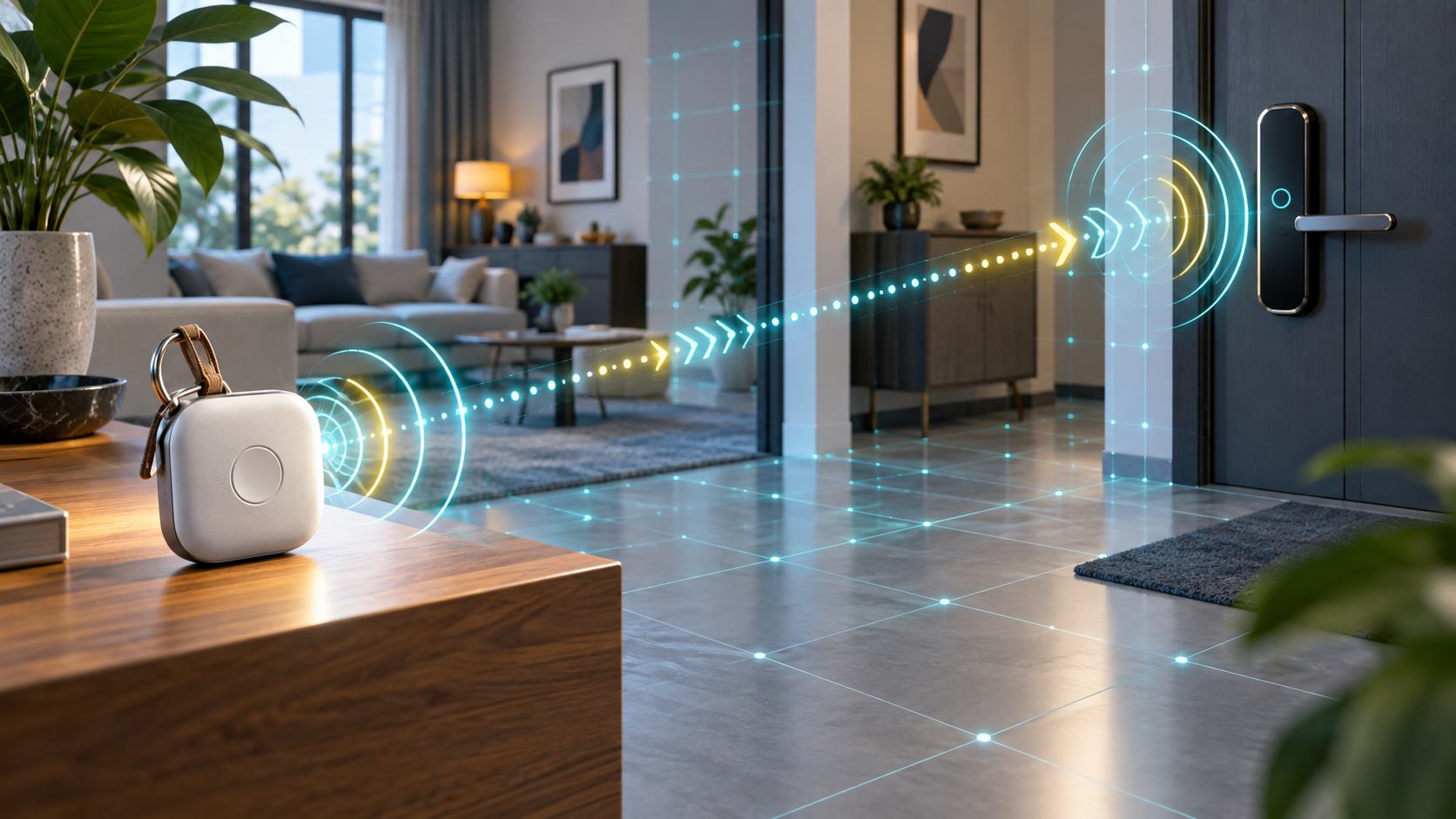
Ultra Wideband (UWB) is a short-range radio technology optimized for measuring distance and relative position between devices. Instead of merely inferring proximity from signal strength, UWB measures signal travel time. Compatible devices can therefore determine precise distance and, in some configurations, direction.
How does UWB work?
UWB sends very short pulses across a wide portion of radio spectrum. Two devices exchange signals, measure time of flight, and convert it into distance. Because radio travels close to the speed of light, tiny timing errors matter, requiring specialized clocks, antennas, and algorithms.
A ranging session normally has an initiator and a responder. They still need an out-of-band channel such as Bluetooth Low Energy to discover each other and securely exchange session parameters. UWB therefore complements Bluetooth more often than it replaces it.
How is it different from Bluetooth, NFC, and GPS?
| Technology | Strength | Good fit |
|---|---|---|
| UWB | Precise distance, possible direction finding, short-range performance | Precision finding, digital keys, indoor positioning |
| Bluetooth LE | Wide adoption, low power, discovery and data transfer | Accessories, beacons, sensors, UWB setup channel |
| NFC | Very short range and explicit tap interaction | Payments, access cards, pairing |
| GPS/GNSS | Absolute outdoor positioning at global scale | Maps, navigation, vehicle tracking |
UWB is not “perfectly accurate.” Android describes precise ranging around 10 cm under suitable conditions, but real results depend on antennas, device orientation, obstacles, multipath reflections, distance, and product implementation.
Practical applications
- Precision finding: a phone shows distance and direction to a nearby tracker.
- Car and door keys: the system verifies that an authorized device is in the expected physical location.
- Smart homes: controls respond to the room or device a user points toward.
- Warehouses and factories: calibrated anchors locate tools, pallets, or robots.
- Spatial experiences: AR interaction, content handoff, and nearby peer discovery.
Why can ranging be safer than RSSI?
Traditional Bluetooth beacons often estimate distance from RSSI, which varies greatly around walls, people, and different transmit powers. UWB uses signal timing and can employ Secure Time Stamp mechanisms to better protect ranging against manipulation and relay attempts.
A UWB chip alone does not make a digital key secure. A complete product still needs cryptographic authentication, key management, replay protection, least privilege, firmware updates, and account recovery.
Compatibility requirements
Both endpoints need UWB hardware and a compatible profile or protocol. A product family name is not enough because regional variants may differ. Android apps can check android.hardware.uwb, and the Jetpack UWB documentation requires Android 12 or later. In Apple's ecosystem, Nearby Interaction provides distance and, on suitable devices, direction to a peer or accessory.
Before buying a lock, tracker, or IoT device, verify the exact phone model, supported ecosystem and profile, regional availability, background-ranging behavior, permissions, Bluetooth requirements, and fallback behavior when UWB is unavailable.
Limitations
- Short range: UWB does not replace GNSS or cellular tracking.
- Obstructions: walls, metal, people, and antenna orientation affect quality.
- Limited availability: many phones and accessories still lack UWB hardware.
- Energy use: continuous ranging must be managed by session and context.
- Privacy: distance and direction expose spatial behavior and require consent, minimization, and retention controls.
Is UWB worth paying attention to?
UWB is valuable when a product must answer “where exactly is the object relative to me?” rather than merely “is it nearby?” That distinction creates more natural trackers, digital keys, and location-aware automation. Buyers should evaluate ecosystem support, interoperability, and security policy instead of relying on the UWB label alone.

No comments yet. Be the first to share your thoughts.