
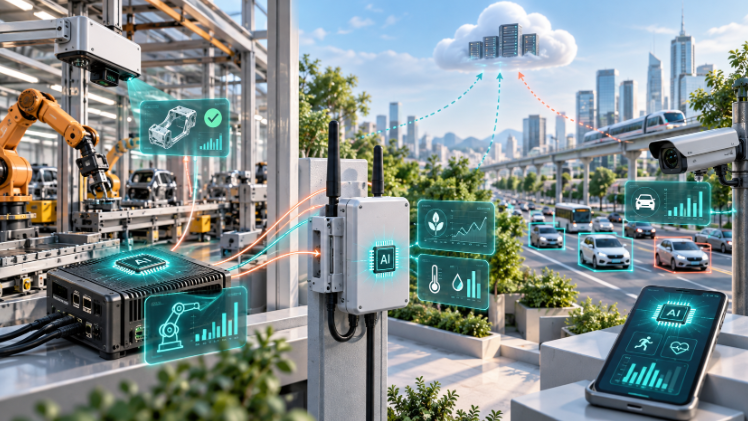
AI does not always need to run in a distant data center. Edge AI brings machine-learning inference closer to where data is generated: cameras, phones, vehicles, industrial controllers, medical equipment, and other connected devices.
What is Edge AI?
Edge AI is the use of trained AI models on local hardware or a nearby edge gateway. A cloud platform may still train and distribute models, but day-to-day inference can happen without sending every image, sound, or sensor reading across the internet.
Edge AI versus Cloud AI
| Factor | Edge AI | Cloud AI |
|---|---|---|
| Latency | Very low because processing is local | Depends on network and server response |
| Connectivity | Can continue offline | Usually requires a stable connection |
| Privacy | Raw data may remain on the device | Data is commonly transmitted to a server |
| Compute capacity | Limited by device resources | Can scale to powerful infrastructure |
Key benefits
Near-real-time response
Local inference is valuable when milliseconds matter, such as detecting a safety hazard, assisting a driver, or stopping a defective product on a production line.
Better privacy
Processing sensitive video, voice, or biometric data locally can reduce exposure. Privacy still requires encryption, access control, retention rules, and secure device management.
Lower bandwidth use
A device can send events or summaries instead of continuous raw data, reducing network cost and pressure on central systems.
Resilience
Factories, farms, vehicles, and remote sites can keep essential intelligence available when connectivity is slow or interrupted.
Where is Edge AI used?
- Quality inspection and predictive maintenance in manufacturing.
- Smart cameras that detect events without streaming all footage.
- Voice, image, and personal-assistant features on phones and computers.
- Driver assistance, traffic monitoring, and fleet safety.
- Retail analytics and responsive in-store experiences.
- Health monitoring devices that provide timely alerts.
Challenges to plan for
Edge devices have limited memory, power, and thermal capacity. Teams must optimize models, manage many hardware versions, distribute updates safely, monitor model drift, and protect devices from physical or network attacks. A model that works in a laboratory may behave differently under real lighting, noise, or temperature conditions.
How should an organization start?
- Choose a use case where latency, privacy, bandwidth, or offline operation matters.
- Define measurable accuracy and response-time targets.
- Collect representative real-world data.
- Test hardware and model performance together.
- Design secure updates, monitoring, and rollback before scaling.
A new infrastructure layer
Edge AI and Cloud AI are complementary. The edge provides immediate local decisions; the cloud provides training, fleet management, analytics, and coordination. Well-designed systems place each workload where it delivers the best balance of speed, privacy, reliability, and cost.

No comments yet. Be the first to share your thoughts.